
During the development of ZHUOZHU’s flexible stone panels, I’ve often been asked the same question by customers: “Wald, the texture of your panels is excellent, but can you offer a wider range of colors? Can you create gradients, blended tones, or specific patterns on the surface?”
To be frank, in our conventional production process, coloring flexible stone panels is achieved by adding pigments during the slurry mixing stage. This means the entire panel comes out in a single uniform color – we can make it red, gray, beige, or any solid color you specify. However, this method cannot produce patterns, gradients, or localized color variations on the surface.
Our customers’ needs are entirely reasonable. Imagine a slate-look feature wall – if every panel is just one flat shade of gray, the texture may still be there, but it lacks the rich color veining and natural layering found in genuine stone. Or a rammed-earth style wall – without the subtle rust-colored mottling naturally present in earth, something feels missing.
So we set out to find a solution – and the answer is 3D digital printing technology.
What is 3D digital printing on flexible stone panels?
In simple terms, after the flexible stone panel is formed and cured, we use high-precision digital inkjet equipment to print pre-designed patterns, textures, or colors directly onto the panel surface. The technology works much like the inkjet printer you might have at home, except our “ink” is specially formulated UV-curable pigment inks, and our “paper” is the flexible panel with its natural stone-like texture.
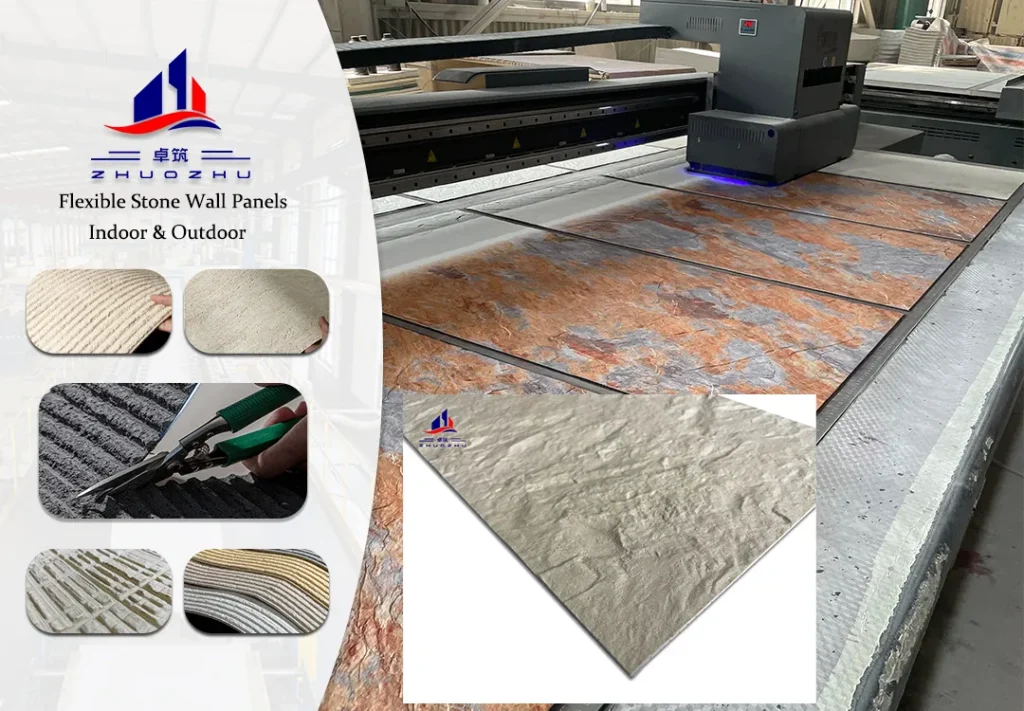
With 3D digital printing, we can achieve:
- Multi-color gradients – natural transitions from dark to light gray, mimicking the color veining of natural stone
- Antique and distressed effects – adding localized dark staining or rust-like spots to the surface
- Custom patterns – printing specific texture directions or decorative motifs according to project requirements
- High-fidelity realism – reproducing high-resolution scans of natural stone directly onto the panel surface, with a level of authenticity far beyond traditional dyeing methods
Why is 3D printing more suitable for flexible stone?
During our R&D, we evaluated other coloring methods, such as screen printing or manual spraying. Ultimately, we chose 3D digital printing for three reasons:
First, it does not compromise the panel’s flexibility. Traditional coloring processes may form a hard film on the surface, affecting bending performance. In contrast, the ink layer in 3D printing is extremely thin and perfectly integrates with the panel surface, without sacrificing the core advantage of our flexible stone panels – their ability to bend and conform to curved walls.
Second, color fastness and weather resistance. Our UV-curable pigment inks are specially formulated to chemically bond with the panel surface after UV curing. Our accelerated aging tests in the lab have shown that printed patterns can maintain their color without fading or chalking for over 5 years in outdoor environments.
Third, flexibility and efficiency. 3D printing is a digital process – no plate-making or mold opening is required. We can produce samples within hours once we receive a customer’s design file, enabling rapid response to custom needs. For small-batch, multi-variety project orders, this is the most efficient solution.
Real-world applications
In our customer projects, 3D printing has already helped turn many design concepts into reality:
- A hotel owner wanted a “ink-wash landscape” effect on a feature wall – we printed a black-to-gray gradient ink-wash texture on the Slate Flexible Stone Panel, resulting in a look akin to naturally formed rock strata.
- A high-end showroom needed to incorporate their brand logo into the wall design – on the Sawn Timber Texture Flexible Stone Panel, we subtly blended the brand colors into the deep grooves of the sawn texture, achieving both visual interest and brand recognition.
- A private residence owner desired a wall that felt like “autumn” – on the Hand-Troweled Earth Flexible Stone Panel, we added warm yellow and rust-red localized overtones through 3D printing, giving the entire wall a sense of seasonal warmth.
Cost and lead time considerations
Many customers worry: “Will 3D printing be expensive? Will it take a long time?”
In fact, the additional cost of 3D printing depends primarily on the complexity of the design and the print area. For natural stone-like gradients or texture enhancements, the cost increase is very modest – far lower than the selection cost of natural stone. As for lead time, since no plate-making is required, the process from design approval to production completion typically adds only 3 to 5 working days.
Summary and recommendations
The core value of flexible stone panels lies in their authentic, natural texture and flexible, bendable installation convenience. The introduction of 3D digital printing technology gives this high-quality “canvas” an even richer expressive capability in color.
If you are working on a project with special color requirements – whether antique finishes or modern abstract patterns – our 3D printing solution can bring it to life. When selecting your preferred texture (whether Woven Texture, Fine Stone Grain, Sawn Timber, Slate, Semi-cylindrical, Pathway, Pathway, Lunar Surface, or Hand-Troweled Earth), feel free to discuss with us whether additional color printing is needed on the surface.
We recommend that you engage with us at the design stage, so we can assess the feasibility of printing solutions and provide sample services in advance. Send us your design drawings, and we’ll turn your imagination into a real wall.
If you have any questions about 3D printing on flexible stone panels, or if you have a specific project to discuss, please don’t hesitate to contact our technical team.
Author: Wald | Head of Product & Technology, ZHUOZHU