
When selecting building materials, waterproof performance is always a critical consideration. For stone‑based products in particular, the water absorption rate directly affects durability, freeze‑thaw resistance, colour retention, and long‑term maintenance costs.
Today, I would like to provide a comprehensive explanation of the waterproof performance of ZHUOZHU’s flexible stone panels. Our products are classified as fully waterproof – and this is not mere marketing language, but an objective conclusion based on material properties and verified test data.
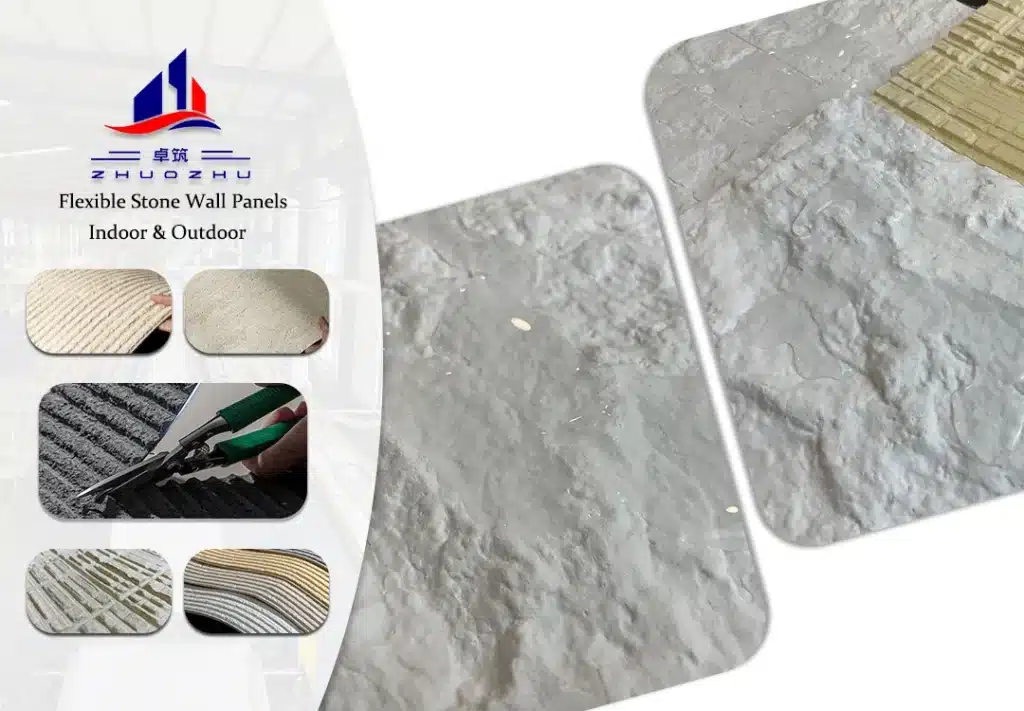
1. What Does “Fully Waterproof” Mean?
“Fully waterproof” means that the material does not undergo significant changes in physical properties or appearance when exposed to moisture over extended periods. For flexible stone panels, this translates to:
- Water molecules cannot penetrate into the panel
- The panel will not swell or deform due to moisture absorption
- The surface will not develop stains or efflorescence from moisture infiltration
- Under freeze‑thaw conditions, micro‑cracks will not occur due to internal water freezing
In more technical terms, the surface density of flexible stone panels approaches that of glass or ceramic. Water can only remain on the surface – it cannot enter the panel itself.
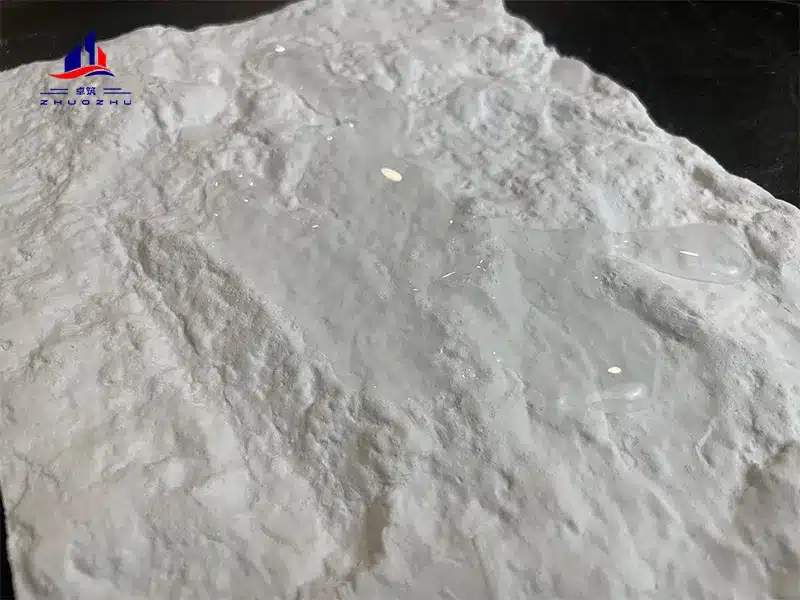
2. Water Absorption ≤ 2%: A Concrete Metric
Under the Chinese national standard (GB/T 4100-2015), ceramic tiles with a water absorption rate ≤ 0.5% are classified as “porcelain tiles”, while those in the 0.5%–3% range are called “stoneware tiles”. The water absorption rate of flexible stone panels has been verified through multiple third‑party tests and is consistently controlled at ≤ 2%.
What does this figure mean in practice? Let’s compare it with several common materials:
| Material | Typical Water Absorption Rate |
|---|---|
| Natural Granite | 0.2%–0.7% |
| Natural Marble | 0.5%–1.5% |
| ZHUOZHU Flexible Stone Panel | ≤ 2% |
| Ceramic Tile (Stoneware) | 0.5%–3% |
| Standard Cement Fibre Board | 10%–15% |
| Natural Sandstone | 5%–12% |
The water absorption rate of flexible stone panels is significantly lower than ordinary cement‑based decorative materials, and sits on par with natural stone and ceramic tiles. In some production batches, our measured values can even reach below 1.5%.
It is worth noting that the water absorption rate of flexible stone panels is not necessarily better the lower it goes. An excessively low rate means the surface becomes overly dense, which may reduce the mechanical interlocking between the adhesive and the panel. A rate around 2% represents a carefully validated balance point – it ensures excellent waterproof performance while still allowing adhesives to form a sufficiently strong bond with the panel surface during installation.
3. The Essence of Water Absorption: Porosity
To understand water absorption, we first need to understand the concept of porosity.
All solid materials contain microscopic pores – the differences lie in their number, size, and interconnectivity. When a material is exposed to moisture, water molecules gradually penetrate through surface‑open pores. A higher water absorption rate indicates more interconnected pores within the material, making it easier for water to enter.
The reason flexible stone panels can achieve a water absorption rate of ≤ 2% lies in the precise formulation of stone powder, fibres, resins, and chemical reagents. The proportion and type of resin emulsion determine the microstructure formed after the slurry cures – the resin encapsulates the stone powder particles, creating a continuous closed membrane between them that blocks capillary pathways, preventing water from being drawn into the panel through capillary action.
Additionally, our production process uses vacuum high‑pressure forming, which further eliminates air bubbles in the slurry, making the panel structure denser and fundamentally reducing porosity.
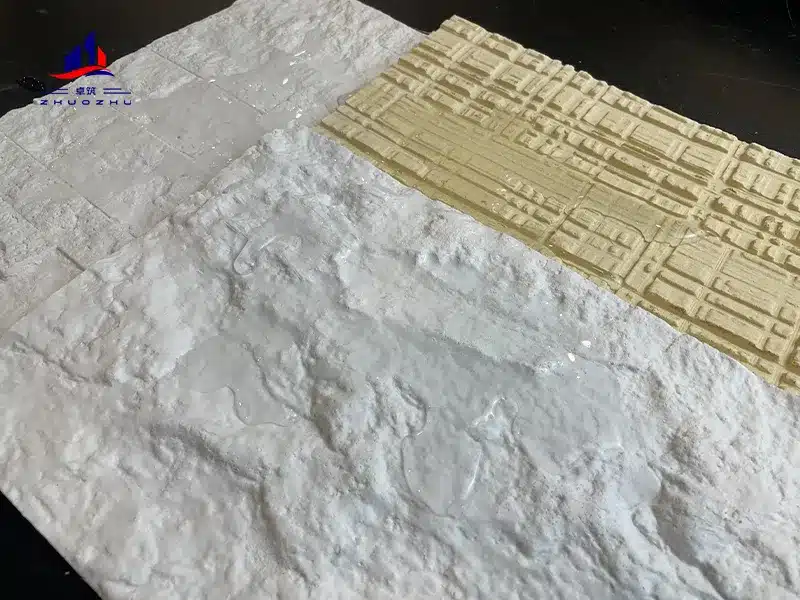
4. Practical Benefits of Full Waterproof Performance
For indoor applications:
- Kitchen splashbacks, bathroom walls, laundry rooms, and other damp areas need not worry about moisture penetration causing mould, discolouration, or substrate damage.
- Cleaning and maintenance are remarkably simple – the dense surface resists stain penetration, and a simple wipe with a damp cloth restores its original cleanliness.
For outdoor applications:
- Rainwater cannot penetrate the panel, so there is no risk of cracking, warping, or freeze‑thaw damage due to moisture absorption.
- The surface will not develop efflorescence (the white crystalline deposits caused by soluble salts being carried to the surface by moisture) – a common problem with natural stone and ordinary cementitious products in outdoor use.
- Colour retention is enhanced – the pigment is sealed within the dense matrix and cannot be leached out or migrated by moisture.
For procurement professionals:
- Lower long‑term maintenance costs. No need for periodic waterproof coatings or worry about repairs due to water ingress.
- Extended service life. Waterproof performance is directly linked to structural stability – without moisture intrusion, there is no expansion stress, no freeze‑thaw damage, and naturally a longer product lifespan.
5. Distinguishing “Waterproof” from “Non‑Breathable”
In the building materials field, “waterproof” and “non‑breathable” are two easily confused but distinctly different concepts.
Some materials are “non‑breathable” (such as plastic membranes) – water vapour cannot pass through them. However, this also means that moisture inside the wall cannot escape to the outside, potentially leading to moisture accumulation and mould growth within the wall structure.
The “waterproof” property of flexible stone panels means that liquid water cannot penetrate, but it does not prevent water vapour from diffusing outward through the microscopic channels within the panel, in gaseous form. In other words, it acts like a “waterproof and breathable” jacket – rain from the outside cannot get in, but trapped moisture from the inside can get out. This is especially important for exterior insulation systems, preventing moisture build‑up within the wall that could compromise insulation performance and structural safety.
6. Our Testing Methods
Beyond official reports from third‑party testing institutions, we have also established routine waterproof performance testing procedures in our own factory:
24‑Hour Immersion Test: Panels are fully submerged in room‑temperature water. After 24 hours, we measure weight change and inspect appearance. Our products show a weight increase of no more than 2%, with no discolouration, blistering, or delamination.
Boiling Water Test: Samples are placed in boiling water for 2 hours to simulate accelerated ageing under extreme heat and humidity. Our products maintain complete structural and visual integrity after testing.
Freeze‑Thaw Cycle Test: Saturated samples are subjected to 50 cycles between -20°C and +20°C. Our products show no cracking, spalling, or reduction in strength.
7. Recommendations for Customers
- Understand the scope of “fully waterproof” correctly. The waterproofing refers to the panel itself not absorbing water. However, this does not mean the joints are also waterproof after installation. Joint waterproofing needs to be addressed with sealants or matching grout. ZHUOZHU’s colour‑matched grout itself has excellent waterproof properties, ensuring overall wall waterproofing after installation.
- For outdoor installation, waterproofing is the foundation, but not the whole story. In addition to the material’s waterproof performance, outdoor applications also require consideration of the overall waterproofing construction of the installation system. We provide detailed installation guidance for each specific project.
- A note on different product series: All our flexible stone panel series (including Woven, Fine Stone Grain, Sawn Timber, Slate, Semi‑cylindrical, Strip Stone, Pathway, Lunar Surface, and Hand‑Troweled Earth) share the same waterproof performance, as they are based on the same core formulation system. Regardless of texture, the water absorption rate is consistently controlled at ≤ 2%, and all are fully waterproof.
8. Conclusion
The fully waterproof performance of flexible stone panels is not an added bonus or a “nice‑to‑have” feature – it is an inherent property determined by the material system and forming process. The concrete metric of ≤ 2% water absorption allows this product to confidently handle everything from indoor damp spaces to outdoor wind‑and‑rain exposed environments.
For distributors and procurement professionals, this translates to fewer quality complaints, lower after‑sales costs, and a longer product lifecycle. For designers and property owners, it means greater design freedom – no need to restrict the use of the material due to waterproofing concerns.
If you have a specific project requirement, please feel free to reach out to us. ZHUOZHU’s technical team can provide you with more detailed technical data and installation solutions.
Author: Wald | Head of Product & Technology, ZHUOZHU