
Hello, I’m Wald, Product and Technical Director at Linyi Zhuozhu New Material Co., Ltd. Today I want to share some exciting news from our R&D department—a breakthrough that solves one of the most persistent problems with flexible stone panels: surface scratching.
If you have ever worked with flexible stone, you already know exactly what I am talking about. If you haven’t, let me paint the picture, because this is a problem that has frustrated manufacturers, transporters, installers, and end users for years.
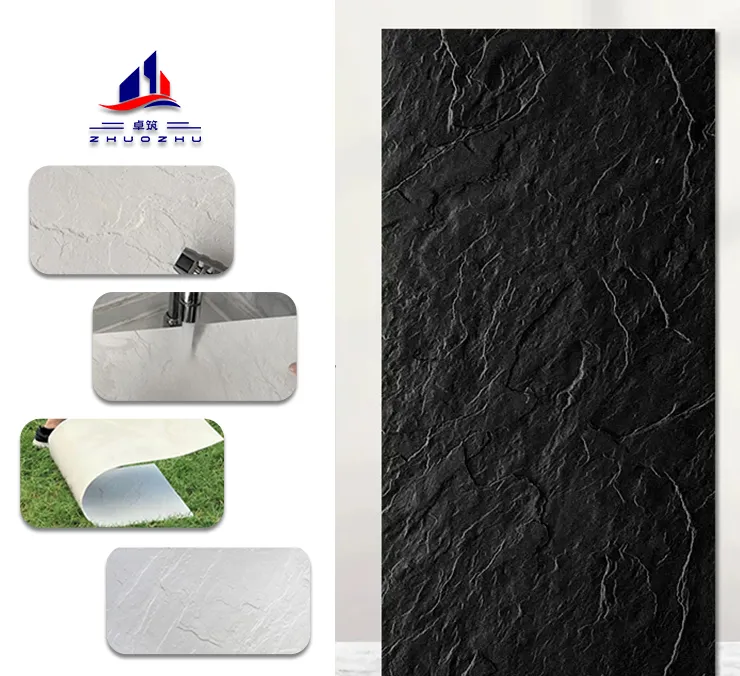

The Problem: A Beautiful Surface That Scratches Too Easily
Flexible stone panels are a remarkable product. They combine the authentic look and texture of natural stone with the flexibility and lightweight properties of a composite material. They can be bent around curves, applied to irregular surfaces, and installed in places where traditional stone would be impossible or impractical. Architecturally, they open up design possibilities that simply did not exist before.
But there was always a weakness, and it was right on the surface.
The flexible stone panel, as it was previously manufactured, had no protective layer on its decorative face. The surface was the decorative layer itself—a mineral-rich veneer that looked beautiful but was vulnerable. And I mean vulnerable in a very practical, everyday way.
Consider what happens with just a fingernail. If you drag your nail across the surface, even lightly, it leaves a white scratch mark. Not a deep gouge, but a visible line that disrupts the uniform appearance of the stone. Now imagine what happens in real-world conditions.

The Three Stages Where Damage Happens
Based on years of feedback from our clients and our own experience, the scratching problem manifests in three distinct stages, each with its own consequences:
Stage One: Transportation
Flexible stone panels are shipped in stacks, often over long distances by sea or land. Despite careful packaging, panels shift during transit. They rub against each other. Edges contact faces. Vibration over thousands of kilometers creates friction points. By the time a shipment arrives, a significant portion of the panels may have surface scratches. This is not a minor cosmetic issue—it is real financial loss. Clients open containers to find that a percentage of their order is damaged and unusable for visible applications.
Stage Two: On-Site Handling and Installation
Even if the panels arrive in good condition, the installation process is another danger zone. Workers handle panels, move them into position, cut them to fit, and press them against adhesives or substrates. No matter how careful the team is, contact happens. A tool brushes against the surface. A panel is laid face-down momentarily on a rough surface. A worker’s glove or belt buckle makes contact. Each of these small events can leave a scratch. And because the scratches are white against the stone color, they are highly visible.
Stage Three: Post-Installation Life
Once installed, the surface remains vulnerable to everyday contact. Furniture moved against a wall. A child’s toy dragged along a baseboard. Cleaning with an abrasive cloth. Over time, the accumulation of minor scratches dulls the appearance of what was supposed to be a premium stone finish.
The Old Solution: Repair, But Never Perfect
For years, the industry’s answer to this problem was repair. When a scratch occurred, it could be touched up with pigment matched to the stone color. This approach has two fundamental flaws.
First, repair is labor-intensive. Someone has to identify each scratch, mix or select the right pigment, apply it precisely, and blend it into the surrounding surface. On a large project, this can consume many hours of skilled labor.
Second, and more importantly, repair is never invisible. The pigment may match the base color, but it cannot replicate the subtle variations, the texture, and the light-reflecting properties of the original surface. Under certain lighting angles, the repaired areas become visible as color differences. The panel no longer looks uniform. For a high-end architectural finish, this is simply not acceptable.
Our Solution: A New Anti-Scratch Coating Technology

At ZHUOZHU, we refused to accept that this was an unsolvable problem. Our engineering team, working in collaboration with other manufacturers who shared our frustration, embarked on a research and development project to find a real solution. The goal was not to make repairs easier—it was to prevent the scratches from happening in the first place.
After extensive testing and formulation work, we developed a new anti-scratch technology based on a protective surface coating.
The process works like this: during production, after the flexible stone decorative layer is formed, we apply a specialized new material via a precision spray coating process. This material forms a thin, transparent protective layer over the entire decorative surface. The coating is engineered to achieve several critical properties simultaneously:
Scratch Resistance
The coating dramatically increases the surface hardness and abrasion resistance of the flexible stone panel. The white scratch marks that used to appear from a fingernail no longer form. The surface resists the everyday contact that previously caused visible damage. In our laboratory testing and in real-world trials, panels with the anti-scratch coating have shown a dramatic reduction in scratch visibility compared to uncoated panels.
Transparency and Appearance Retention
A protective coating is useless if it changes the appearance of the product. The new material we selected is highly transparent and color-neutral. It does not yellow, it does not alter the color or texture of the stone beneath, and it does not create an unnatural gloss or sheen. The flexible stone still looks like flexible stone—just more durable.
Adhesion and Flexibility
Flexible stone is, by definition, flexible. It bends. It moves with temperature changes and substrate movement. The anti-scratch coating must be able to flex with the panel without cracking, peeling, or delaminating. We tested adhesion under repeated bending cycles, and the coating remains firmly bonded to the surface.
Weather and UV Resistance
For exterior applications, the coating must also resist UV degradation and weathering. It does not chalk, it does not lose its transparency, and it does not break down under prolonged sun exposure.
What This Means for Our Clients
The practical benefits of this development are significant, and they apply across the entire supply chain:
For distributors and importers, the reduction in transportation damage means fewer claims, less financial loss, and more predictable margins. Panels arrive in usable condition, which is what they paid for.
For installers, the reduced risk of scratching during handling means less time spent on touch-up and repair. The installation goes faster, and the final result is cleaner. Workers do not have to treat every panel like a fragile artifact—they can handle the product with normal care, not extreme anxiety.
For end users and property owners, the finished installation looks better on day one and stays looking better over time. The premium appearance they paid for is preserved, not degraded by the minor accidents of daily life.
For architects and designers, the anti-scratch coating removes a barrier to specifying flexible stone in high-traffic areas or applications where durability was previously a concern. The design possibilities expand.
A Collaborative Achievement
I want to emphasize that this was not a solo effort. ZHUOZHU’s engineers worked alongside other manufacturers who recognized the same problem and were willing to invest in a solution. This kind of collaboration is healthy for the industry. When companies compete only on price, quality suffers—as I discussed in my recent article about the metal decorative panel market. But when companies collaborate on genuine technical challenges, the entire market benefits. This anti-scratch technology is a step forward for everyone who works with flexible stone, not just for ZHUOZHU.
Availability and Next Steps
We are now integrating this anti-scratch coating into our production process for flexible stone panels. As with any new technology, we are scaling up carefully, and we welcome inquiries from clients who want to learn more or discuss how this can benefit their specific projects.
If you have experienced the scratching problem with flexible stone in the past, or if you are considering flexible stone for a project and want to know more about the anti-scratch version, reach out to me directly. I’m Wald, and I’m always glad to talk about how we can make our products work better for you.