
Since ZHUOZHU launched its flexible stone panels, one of the most frequent pieces of feedback we’ve received from customers is about their flexibility. It sounds like a simple attribute, but in real projects, the installation convenience and design freedom it brings often exceed the expectations of designers and contractors alike.
Today, I would like to provide a systematic overview of the installation methods, application scenarios, and the differences between indoor and outdoor use of flexible stone panels – to help you better understand and make the most of this material.
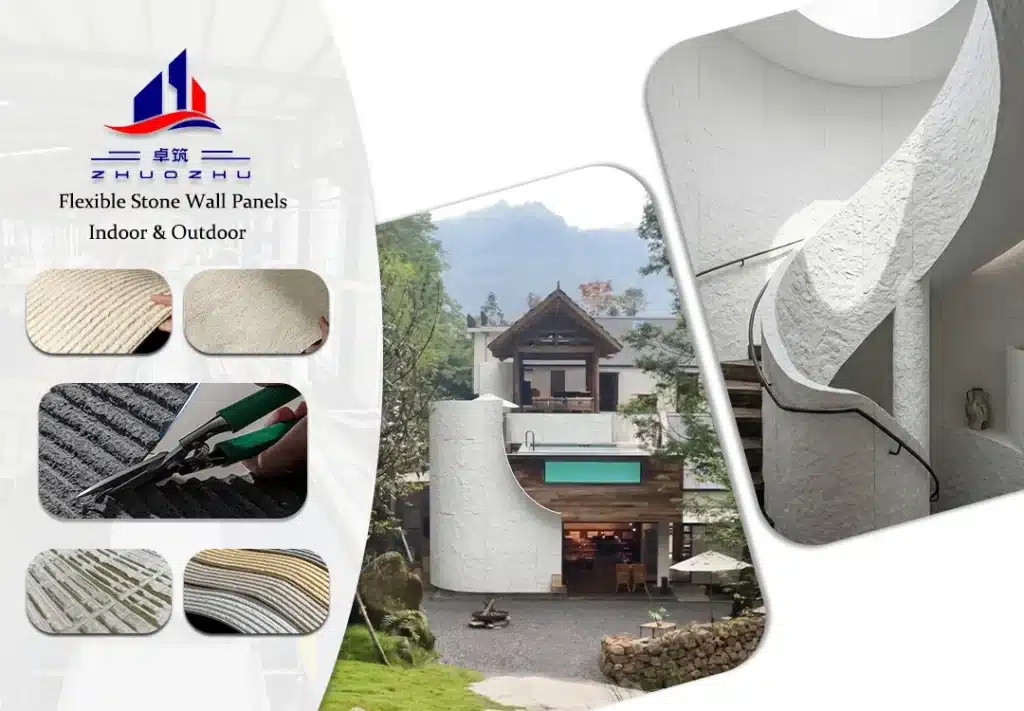
1. Flexibility: The Core “Hard Power” of Flexible Stone
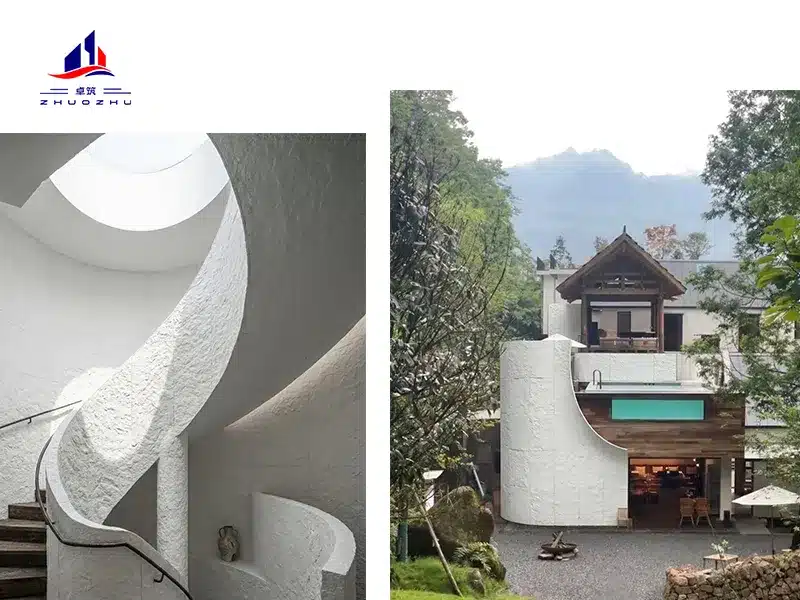
The reason flexible stone panels are called “flexible” is that they are made from natural stone powder, fibres, resins, and chemical reagents, formed through a special process that gives the panels excellent bending performance. We have conducted extreme tests: within a reasonable thickness range, they can conform to the vast majority of architectural curved surfaces – from gentle curved walls to tight column cladding, from arch profiles to wavy ceilings. They can be installed on virtually any wall surface.
What does this mean in practice? It means designers no longer have to alter their designs to accommodate the material. You can freely incorporate curves, arcs, and irregular structures into your spaces, and flexible stone panels will follow them seamlessly. This is something that natural stone, ceramic tiles, and even most metal cladding panels cannot achieve.
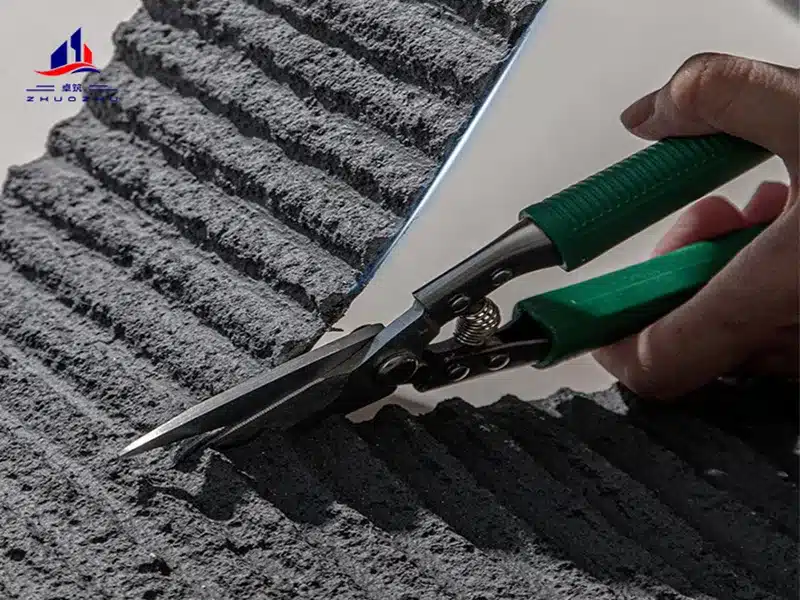
On the construction side, the softness of the panels also brings clear benefits: easy cutting – a standard utility knife or light cutting tool will do; lightweight handling – no heavy machinery required; and flexible installation – a single worker can work efficiently, reducing installation time by 30%–50% compared to traditional stone.
2. Two Installation Methods: Grouted and Seamless – Two Aesthetic Expressions
Flexible stone panels support two installation methods – grouted (with visible joints) and seamless. This is not a technical limitation but a deliberate design choice.
Grouted installation preserves the natural gaps between panels, similar to the way traditional tiles or stone are laid. The visible joints clearly outline each panel, reinforcing a sense of modular order. This approach suits modern minimalist, industrial, or rhythmically patterned commercial spaces. The joint width can be adjusted according to design requirements – from tight joints to wide joints.
Seamless installation, on the other hand, treats the joints between panels to be nearly invisible, creating a unified, continuous visual effect across the entire wall. This method is especially suitable for spaces that demand a sense of continuity and grandeur – such as full-height walls in hotel lobbies, immersive background walls in showrooms, or main feature walls in private residences. Seamless installation allows the natural texture of flexible stone to extend without interruption, as if the entire wall were carved from a single block of natural stone.
Grout Colour Matching: Details Define Quality
Whether you choose grouted or seamless installation, the treatment of joints directly affects the final result. For this reason, ZHUOZHU provides colour‑matched grout for every flexible stone panel series.
This is not a casual add‑on service. If the grout colour does not match the panel, even the finest panels will look jarring at the joints. We have carefully formulated matching grout colours based on the texture and primary tones of each product – from the dark grey series of Slate, to the warm earth tones of Rammed Earth, to the soft neutrals of Pathway – ensuring a natural, seamless colour transition at every joint.
For grouted installation, the matching grout turns the joints into a design asset rather than a drawback; for seamless installation, it helps achieve a truly “invisible” finish.
3. Ultra‑Low Water Absorption: The Confidence for Outdoor Applications
Another key property of flexible stone panels is their extremely low water absorption.
This characteristic comes from our repeated formulation trials during R&D. The gradation of stone powder, the ratio of resins, and the combination of chemical additives – every variable affects the density and water resistance of the final product. The final formulation yields a surface that is dense, with very low porosity, making it difficult for water to penetrate.
The direct benefit of low water absorption is that flexible stone panels are fully suitable for outdoor use. They are not afraid of rain exposure, will not swell or deform due to moisture absorption, and will not crack during freeze‑thaw cycles. Our accelerated ageing tests in the lab have confirmed that the panels maintain stable physical properties and appearance in outdoor environments over extended periods.
This means that whether for building facades, garden walls, community entrances, landscape retaining walls, or retail storefronts, flexible stone panels are a reliable choice.
4. Key Differences Between Indoor and Outdoor Installation: Different Methods for Different Requirements
Since flexible stone panels can be used both indoors and outdoors, why are the installation methods different?
This is a question many customers ask. The answer is: the difference in installation methods does not come from limitations of the material itself, but from the different demands of the application environment and usage scenarios.
Indoor installation typically takes place in a controlled environment – no wind and rain, no extreme temperature fluctuations, and no concerns about structural movement. Therefore, indoors, panels can be installed using direct‑adhesive or dry‑hang methods, with standard tile adhesives or structural adhesives providing strong bonding. The process is fast, well‑established, and cost‑effective.
Outdoor installation faces completely different challenges. First, exterior walls are directly exposed to wind, rain, sunlight, and temperature changes, requiring higher durability and shear strength from the adhesive layer. Second, different regions have their own safety codes and policies for exterior cladding materials – such as additional fixing measures in seismic zones, fall‑risk control standards for high‑rise buildings, and special wind‑pressure requirements in coastal areas.
For these reasons, outdoor installation typically requires reinforced dry‑hang systems or back‑anchored fixing, using specialised weather‑resistant adhesives and metal anchors to ensure the panels remain securely attached even under extreme weather conditions. This is not because flexible stone itself is “not strong enough”, but to meet building safety codes and ensure the material performs durably in outdoor environments.
Our recommendation: If you plan to use flexible stone panels for an outdoor project, please consult us at the design stage. Based on the local climate, building height, and relevant regulations, we can provide a tailored installation plan and technical support.
5. Conclusion
The flexibility of flexible stone panels allows them to be installed on virtually any wall – flat or curved, indoors or outdoors. Two installation methods (grouted and seamless), combined with colour‑matched grout, offer greater freedom in design expression. The ultra‑low water absorption provides a solid technical foundation for outdoor applications, and the distinction between indoor and outdoor installation methods reflects our respect for both building safety and material performance.
If you are planning a project – whether indoors or outdoors, whether walls are flat or curved – we welcome you to contact us at any time. ZHUOZHU’s technical team is happy to get involved from the design stage, offering the most suitable material selection and installation advice for your needs.
Author: Wald | Head of Product & Technology, ZHUOZHU